During Marché du Film, I spoke with and listened to a film industry immersed in AI technology
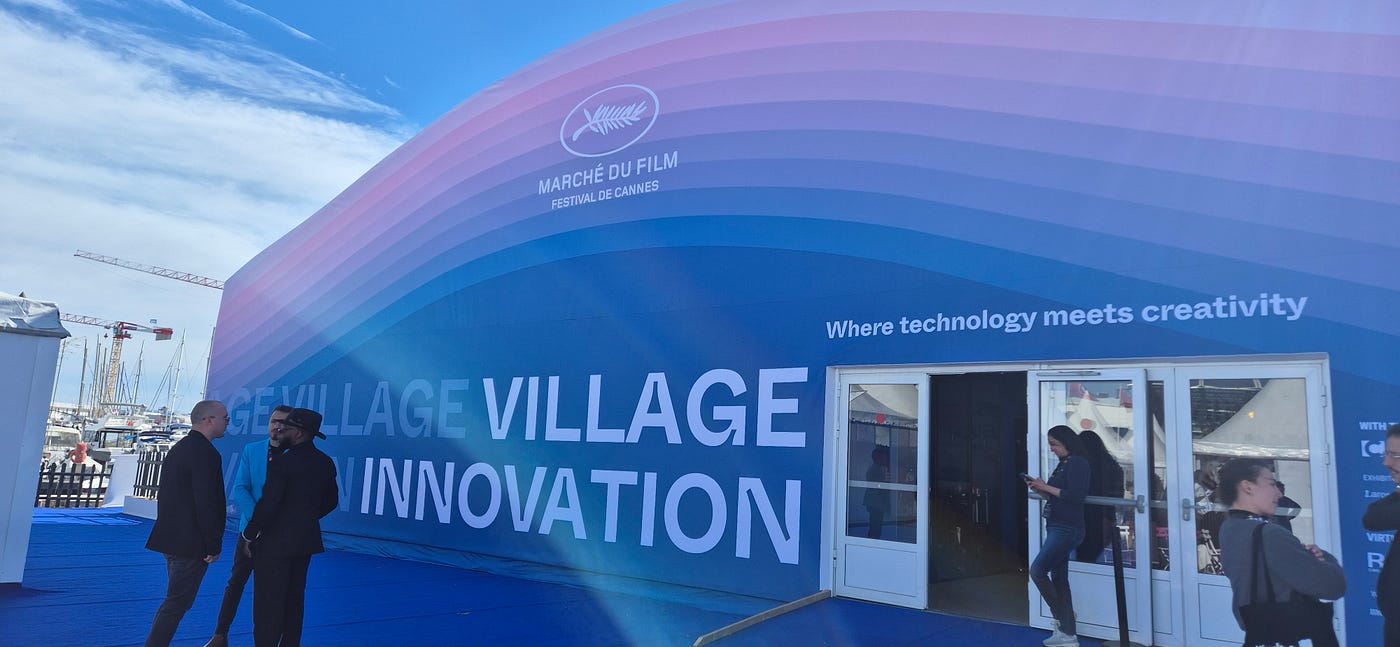
At Marché du Film, AI felt like a business model taking shape in public rather than a distant abstraction. The language had shifted, with AI now framed as production support that helps with brainstorming, editing, analysis, VFX, and workflow, while the creator remains human. That distinction mattered. In Cannes, the conversation centered on control, and on tools that promise to speed up development, sharpen decision-making, and ease the grind of production without stripping away authorship.
Flawless and Respeecher were among the names in the mix at The Village Innovation and AI for Talent Summit, alongside Disney Accelerator-linked companies such as Animaj and ElevenLabs. The discussions reflected a film business in which AI is no longer peripheral, but increasingly part of the machinery. What stood out was the extent to which filmmakers and tech founders were sharing the same stage, with the debate centered not on machine versus artist, but on collaboration, authorship, and control. The question now is where assistance ends, and creation begins, and how original work can be protected as AI becomes more deeply embedded in the industry.
“The buzz in Cannes and the buzz in the industry, it does feel like it’s definitely a turning point,” said Scott Mann, co-chief executive of Flawless, which specializes in AI-assisted post-production.
Darren Aronofsky’s Primordial Soup and Steven Soderbergh’s John Lennon: The Last Interview sat at the centre of a debate that has shifted from whether AI should be in the room to how it is already being used. Soderbergh’s use of Meta AI tools on roughly 10% of the film made that argument harder to dismiss, because it took the conversation out of the abstract and into a completed work screening at Cannes. Aronofsky’s AI-focused studio, and his pitch that the technology can help lower barriers for storytellers, added a more optimistic strain to the discussion. The tension was obvious. Cannes gave AI greater institutional visibility at the same time as a lot of filmmakers remained deeply wary of it.
Meta’s presence on the Croisette, and its long-term partnership with the festival, underlined how quickly AI has moved from novelty to structural force. Guillermo del Toro’s pushback against the idea that art can be made through an app captured the opposite view in a single line. The market side mattered too. Kling AI’s Marché du Film session made clear that the industry is no longer treating AI as a side issue, but as part of the business of making and selling films. What emerged was not a neat consensus but a split picture: experimentation on one side, and anxiety about authorship, labour, and control on the other.
Actors weigh in on film and AI debate
At Cannes, filmmakers and actors have been drawing their own lines around AI, or at least putting forward clear views on where it fits in the industry. On opening day, Demi Moore, a member of the jury, said fighting AI “is a battle we will lose.” The following day, honorary Palme d’Or recipient Peter Jackson said, “I don’t dislike it at all. To me, it’s just a special effect. It’s no different from other special effects.” Filmmaker James Gray, whose family drama Paper Tiger was one of the weekend’s standouts, sounded similarly unconcerned. “In some cases, it can be a very helpful tool,” Gray said in an interview. “I don’t think in our lifetime, or even our children’s lifetimes, it will come close to mirroring the only true infinite we know, which is the soul.”
What felt different this year was that AI was no longer being framed only as a threat to jobs or a force that could disrupt the film industry. Instead, several companies pointed to a more practical model, with assistive AI taking priority over purely generative AI, protecting IP while saving time and money as a collaborative tool. Examples such as AI dubbing suggested that the technology is already finding a place in production.
There was still plenty of resistance from some major directors, but that now feels like part of the broader split in the industry rather than a settled verdict. Some filmmakers will almost certainly come around once they see how much time and money the tools can save in getting projects greenlit, while others will stay loyal to older methods, and both positions can coexist. Filmmakers will always make films in their own way. Alongside that, a new wave of AI video creators such as Gossip Goblin is building striking worlds with small teams, and there is clearly room for that too.
Ginger Liu is the founder of Hollywood Film PR agency, Ginger Media & Entertainment, a journalist and researcher on technology and entertainment, an MFA photographer and filmmaker, and host of the podcast Digital Afterlife: Hollywood & AI Tech