Getty Insists Landmark UK Lawsuit isn’t a Threat to AI, Disney and Universal Sue Midjourney Over Image Use, Moments Lab Raises Funds to Develop AI Tools for Film Studios
Disney and Universal Sue Midjourney Over Image Use
Disney and Universal have filed a lawsuit in Los Angeles federal court against AI firm Midjourney, alleging the company’s image generator illegally replicates characters from franchises including Star Wars, Frozen, and Despicable Me. The studios say the tool produces countless unauthorized copies, sometimes even displaying Disney watermarks, and cite examples such as Yoda, Spider-Man, the Hulk, and Iron Man among the images generated. Disney and Universal claim Midjourney earned $300 million last year and is preparing to launch a video service, intensifying concerns over the use of copyrighted material in AI-generated content.
French Government Removes AI Video Over Historical Errors
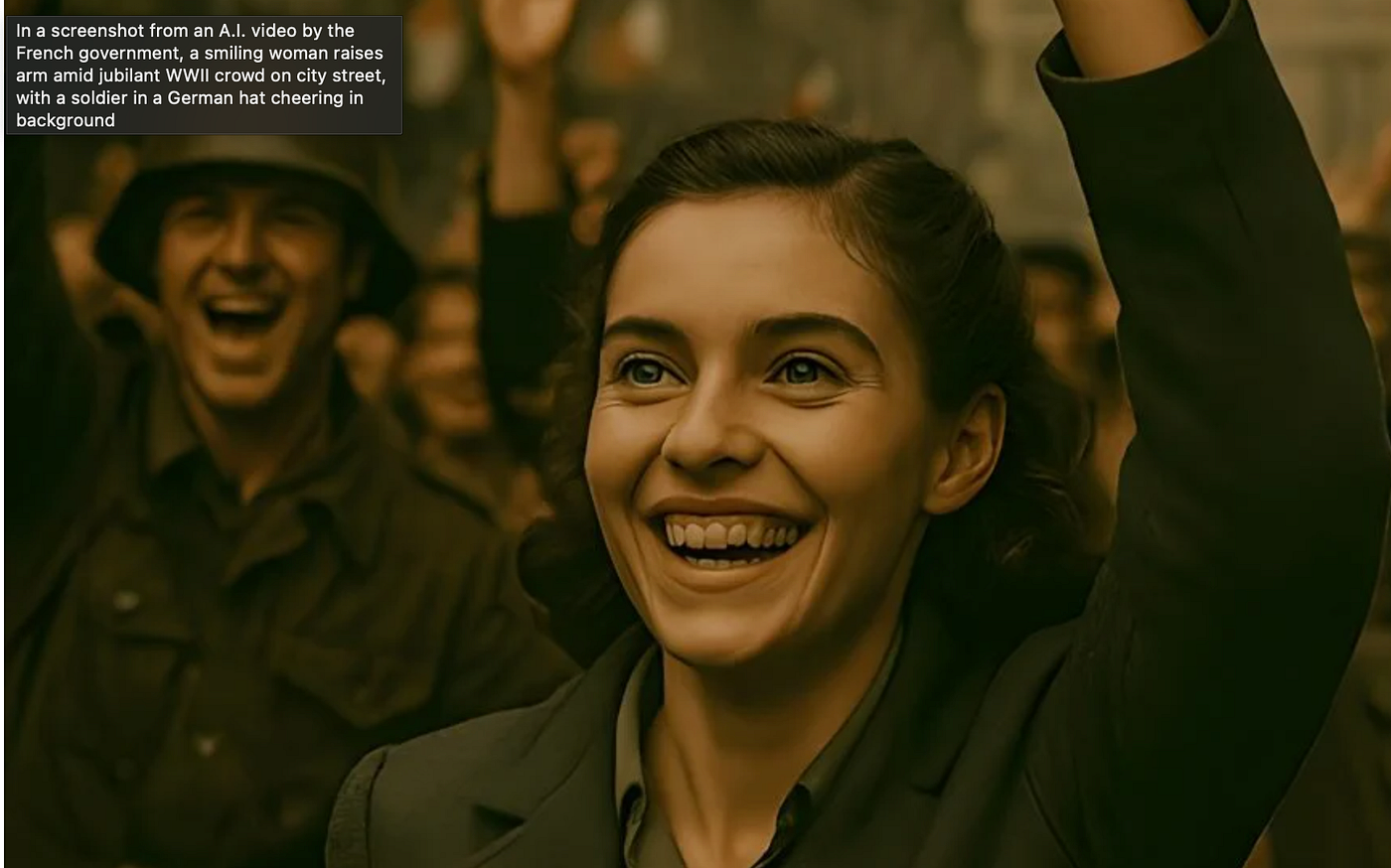
Maybe creatives don’t need to worry just yet about losing their jobs. To mark National Resistance Day on May 27, the French government posted a 27-second AI-generated video on Instagram and TikTok, aiming to engage younger audiences with support from the Ministry of Education. But officials failed to check the video for historical accuracy. One scene shows a soldier in a German-style helmet among celebrating Parisians in August 1944, while a Japanese flag, Nazi Germany’s wartime ally, appears in the background. Oops.
Darren Aronofsky’s Primordial Soup and Google DeepMind AI Partnership
Darren Aronofsky, known for films such as “The Whale” and “Black Swan,” has teamed up with Google DeepMind to explore AI-driven storytelling. His studio, Primordial Soup, is producing three short films by emerging directors using Google’s AI tools, including the new text-to-video model Veo. The first, “Ancestra” by Eliza McNitt, premieres June 13 at the Tribeca Festival. Google stresses that “Ancestra” is a live-action film with real actors, though enhanced with AI-generated effects, such as a baby grasping a mother’s finger. The partnership was highlighted at Google’s I/O event, where the company unveiled Veo 3 — capable of generating video with sound and speech — and introduced Flow, an AI-powered film editing tool.
Getty Insists Landmark UK Lawsuit isn’t a Threat to AI
Getty Images has accused Stability AI of training its image-generation model on Getty’s vast archive of copyrighted photographs, sparking a high-profile copyright and trademark infringement case in London’s High Court. Getty represents nearly 600,000 content creators worldwide and alleges that Stability’s program, Stable Diffusion, even produces images bearing Getty watermarks. The agency claims Stability was “completely indifferent to what they fed into the training data” and described the AI developers as “a bunch of tech geeks” unconcerned about the impact of their technology. Stability AI, whose board includes Oscar-winning director James Cameron, dismissed Getty’s claims as “fanciful” legal maneuvers and called the lawsuit an “overt threat” to the generative AI industry. The company alleges Getty is spending around £10 million to fight what it sees as an “existential threat” to its business.
Advertising Sector Faces Rising Fears Over AI Job Losses
Ad agencies are facing fresh turmoil from a familiar source: Big Tech. For more than a decade, Google and Meta have dominated online advertising by providing powerful tools for publishers and buyers, capturing nearly two-thirds of the £45bn spent by UK advertisers this year. Now, Meta CEO Mark Zuckerberg is preparing to launch AI tools that will allow advertisers to fully create and target campaigns on his platforms, raising fears of the “death of creativity” and widespread agency job cuts. The new AI-driven ad tools are expected to roll out by the end of next year. In a recent interview, Zuckerberg called the technology a “redefinition of the category of advertising,” adding, “You don’t need any creative, you don’t need any targeting, you don’t need any measurement, except to be able to read the results that we spit out.” His remarks have fueled concerns that much of the advertising industry could soon be made obsolete.
Industry Guilds Protest AI at Annecy Animation Fest
During the Annecy International Animation Film Festival and MIFA market, around 150 protesters from animation, video game, screenwriting, and actors’ guilds rallied against the use of generative AI in entertainment, warning that it threatens creative jobs. Demonstrators gathered on La Paquier lawn in front of the Bonlieu, carrying signs and union flags. A statement signed by more than 20 creative organizations, including The Animation Guild (U.S./Canada), BECTU (UK), Game Workers United Ireland, Animation Workers Ireland, and France’s SPIAC-CGT, was read by Lauri Sanders, a Belgium-based director and head of the AI task force for the ABRACA union.
SAG-AFTRA Plan Lets Digital Replicas Join Strikes
SAG-AFTRA’s tentative new Interactive Media Agreement introduces AI protections allowing performers to withdraw consent for their digital replicas during strikes, effectively sending their virtual counterparts to the picket line. The proposed contract, which follows the suspension of a year-long strike after union and game studios reached a deal, requires studios to obtain informed consent before using AI to create digital replicas of performers. The agreement also sets collectively bargained minimum pay for digital replicas made from IMA-covered performances, and establishes higher minimums, 7.5 times the standard rate, for “Real Time Generation,” such as AI-powered chatbots voiced by performers in games. Additionally, studios must pay secondary performance fees when visual performances are reused in other projects. The deal has been approved by SAG-AFTRA’s National Board and now awaits ratification by union members.
Moments Lab Raises Funds to Develop AI Tools for Film Studios
AI video startup Moments Lab is targeting the film production industry, having raised about $24 million in a recent Series B funding round, according to Business Insider. The French company has now secured over $37 million in total to develop AI tools for film studios. Moments Lab’s main product, MXT-2, acts as an AI film librarian, sorting human-shot footage by subject, actor, and location. With its latest funding, the company plans to develop an “agentic AI tool” — software designed to function as an autonomous assistant. If successful, the tool could process raw footage and deliver rough edits based on text prompts, leaving human editors to refine the AI’s output. However, such AI agents have so far proven difficult to scale and remain prone to technical issues.
Incantor Launches Tool to Track IP Rights in AI
Incantor AI has launched what it calls the first AI model capable of tracking creator attribution and intellectual property rights across all generative AI content produced on its platform, according to Variety. The company is partnering with agency Verve, which will advise on the rollout of Incantor’s content creation platform and guide its integration into the entertainment industry. This includes exploring uses in content localization, rights management, and creative production workflows, while supporting artists and the creative community. Incantor’s core technology is built on a proprietary Light Fractal Model, which the company says differs from large language models like OpenAI’s GPT, Google’s Gemini, and DeepSeek. Unlike those models, which rely on massive datasets that may include unauthorized content, Incantor’s approach uses minimal, fully licensed training data and requires less computing power. The platform is designed to track copyrighted material attribution with high precision.
Ginger Liu is the founder of Hollywood’s Ginger Media & Entertainment, a researcher in artificial intelligence and visual arts media, and an entrepreneur, author, writer, artist, photographer, and filmmaker. Listen to the Podcast — The Digital Afterlife of Grief.