AI startups, researchers, creatives, thought leaders, and journalists on artificial intelligence
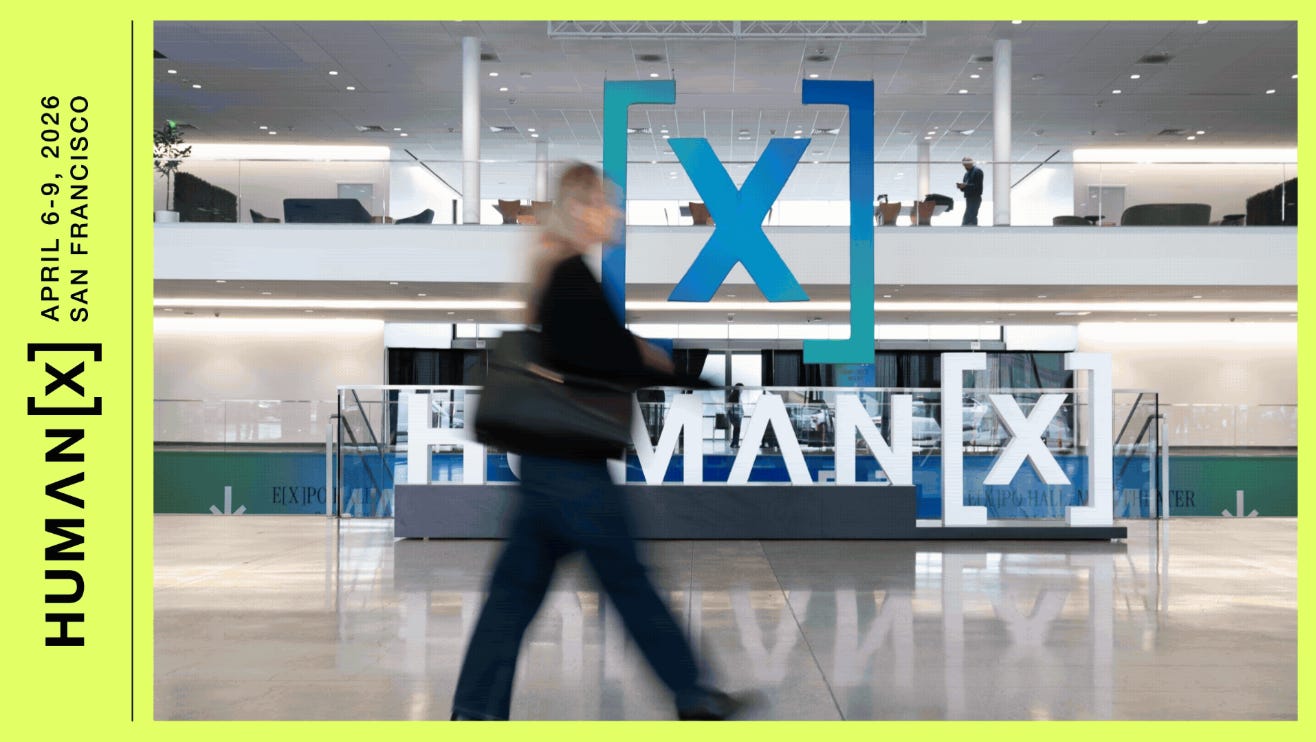
HumanX took over San Francisco this week, drawing more than 6,500 attendees, with an impressive 60% at VP level or above, alongside 400+ sponsors, 300+ speakers, and a packed media presence of 350 journalists. Held across several days in April 2026, the event brought together some of the biggest names shaping AI right now. Speakers and participants included leaders and voices connected to companies like OpenAI, NVIDIA, Google DeepMind, Microsoft, and Meta, alongside a surge of fast-rising startups pushing into film, media, healthcare, and enterprise AI.
April 7 in San Francisco
The opening day of HumanX set the tone for the week ahead, with a clear shift in focus from AI as a tool to AI as an active participant in how work gets done. AWS CEO Matt Garman led with what he framed as an “agentic AI inflection point,” arguing that the technology is already capable of delivering production-level outcomes. The real constraint, he suggested, is organizational rather than technical. Most companies are still treating AI as automation layered onto existing workflows, rather than rethinking how decisions are made and who, or what, is responsible for them.
GLIU Media & Entertainment is a reader-supported publication. To receive new posts and support my work, consider becoming a free or paid subscriber.
At scale, this becomes less about deploying models and more about redesigning the structure of work itself. That question of long-term value carried through in a session with Winston Weinberg, CEO of Harvey, who focused on what happens after adoption. As AI becomes embedded across organisations, the challenge is no longer access but durability. Where does value actually compound, and how do early implementation choices shape outcomes over time? His view pointed to a more strategic phase of AI deployment, where success depends on sustained integration rather than short-term wins.
From there, the conversation turned inward with OpenAI’s Srinivas Narayanan, who offered a look at how the company builds its own products. His focus was on speed and iteration, with internal use of AI agents playing a central role in accelerating development. The idea of an “agent-first” future ran throughout, not just for large enterprises but for startups building from the ground up with these systems as core infrastructure rather than add-ons. Across the first day, a pattern emerged. The discussion was less about what AI can do and more about what organisations are prepared to change in order to use it properly.
AI for sustainability – Al Gore
The Generative AI Revolution
The future of academia in AI research – Fei Fei Li
How does Fei Fei Li feel about being called the ‘godmother of AI’
April 8 in San Francisco
HumanX shifted firmly into substance over spectacle, with a series of heavyweight sessions tackling the less glamorous but more urgent question facing AI right now: how to make it actually work. Andrew Ng of DeepLearning.AI, alongside Coursera CEO Greg Hart, opened with a blunt assessment of the growing AI skills gap. The technology, they argued, is moving faster than most organizations can realistically retrain their workforce. Their focus was not on distant futures but on immediate responsibility. Companies can no longer treat AI literacy as optional, yet the question of who should lead that effort, employers, educators, or governments, remains unresolved.
If Ng’s session focused on people, SambaNova Systems CEO Rodrigo Liang turned to the machinery behind it all. His argument was clear: the next phase of AI will not be defined by ever-larger models, but by the systems that run them. As inference costs begin to dominate, the industry is being forced to rethink its infrastructure from the ground up. The implication is a quiet reckoning, where efficiency and architecture may matter more than raw model scale.
April 9 in San Francisco
HumanX turned its attention to how AI is rewriting the everyday experience of work, communication, and health, with a clear throughline: the future of AI is less about standalone models and more about embedded, human‑centred systems. Zoom chief technology officer Xuedong Huang opened the day by outlining how the company is trying to move beyond video calls into what he described as an AI‑first era of work. With hundreds of millions already using Zoom as a communication backbone, the platform is embedding AI into meetings, messaging, and workflows via a federated model and redesigned interfaces. The question is no longer whether organisations can use AI, but whether Zoom can make it a genuine productivity lever for everyone, not just a shiny add‑on.
Health tech took a more intimate turn with a session from ŌURA CEO Tom Hale and Midi Health chief executive Joanna Strober. They sketched a future where AI delivers continuous, always‑on insights, tailored to the individual. Yet with such data comes responsibility. The conversation circled how to balance innovation with trust in one of the most sensitive domains there is, medicine, and how to avoid layering algorithmic logic over deeply personal health journeys. That theme of responsibility and reskilling carried through to a panel on workforce transformation, featuring Robin Daniels of Zensai, Bianca Anghelina of AILY LABS, and Adit Jain of Leena AI.
Their message was pragmatic: AI is reshaping roles faster than most companies can react. The key, they argued, is using real‑time data to understand emerging skills gaps, then building systems that help employees learn at machine speed. The blunt question to HR leaders hung in the air. Are your teams learning fast enough to stay competitive, or are they already on the wrong side of the AI‑driven curve?
If this year’s HumanX in San Francisco proved anything, it’s that the AI conversation is finally outgrowing the hype cycle and settling into the real world: workflows, wages, and wellbeing. What once felt like a theoretical race between labs and cloud giants now looks like a distributed, messy, but very practical reshaping of how people work, communicate, and get better.
By the time HumanX rolls into Las Vegas in 2027, the questions won’t be about whether AI is ready for the enterprise, but whether enterprises are ready for AI. The big platforms are already baking AI into meetings, data stacks, and health tools, but it’s the startups that will fill in the blanks.
HumanX Amsterdam takes place on September 22–24.